
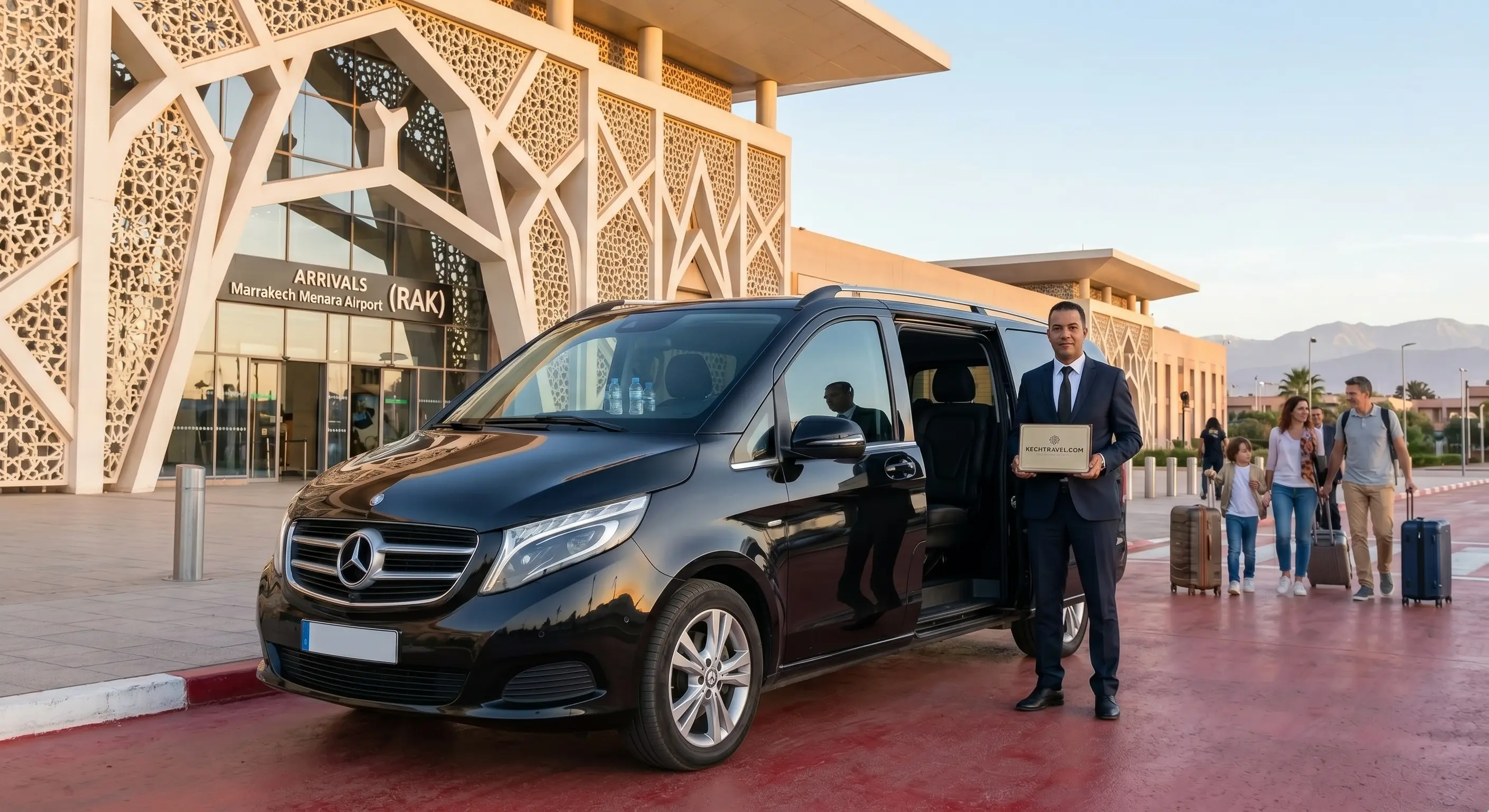

The Definitive 2026 Guide to Hiring a Private Driver in Marrakech: Prices, Fleet Insights, Logistics, and Insider Travel Secrets
The Changing Landscape of Moroccan Travel in 2026
Marrakech is a city that defies simple definition. It is a sensory kaleidoscope where the ancient past collides dynamically with contemporary luxury. As we step into 2026, the red city has experienced an unprecedented evolution in tourism infrastructure. With major global events on the horizon, upgraded transit hubs, and an influx of international travelers seeking bespoke, high-end experiences, the need for seamless, reliable, and sophisticated local transit has never been more critical.
For the discerning traveler, the primary challenge of visiting Marrakech is no longer finding world-class accommodations or exquisite dining—it is navigating the complex, often chaotic logistical landscape that exists between them. From the moment your flight descends over the snow-capped High Atlas Mountains and lands at Marrakech Menara Airport (RAK), you are faced with a fundamental choice: will you submit your precious holiday time to the unpredictable whims of local transit, aggressive negotiation cycles, and unvetted drivers? Or will you invest in the absolute certainty, safety, and tailored luxury of a premium transportation service?
Hiring a private driver in Marrakech is not merely a statement of luxury; it is a calculated operational strategy for maximizing your time, peace of mind, and physical comfort. In this definitive 2026 price and logistics guide, we pull back the curtain on the entire private transport industry in Morocco. We will dissect exact market rates, review elite fleet options including the Mercedes-Benz V-Class and S-Class, outline operational realities across complex multi-day itineraries, and provide you with the exact tactical knowledge required to secure optimal transport solutions for your upcoming journey.
Chapter 1: The Modern Case for Private Transportation vs. Traditional Alternatives
To truly appreciate the value of dedicated private transport, one must understand the structural limitations of the alternative options available in Marrakech as of 2026. The local transit ecosystem is broadly divided into ‘Petit Taxis’ (small urban vehicles restricted to city limits), ‘Grand Taxis’ (larger, often older shared vehicles operating fixed intercity or suburban routes), ridesharing applications (which face ongoing regulatory volatility and localized geo-restrictions), and self-driving car rentals.
The Petit Taxi Conundrum
Petit Taxis are a ubiquitous sight across Marrakech, painted in a distinctive ochre hue to match the city walls. While they are technically required by law to utilize digital taximeters, the reality for international tourists is often an exhausting exercise in financial negotiation before every single journey. During peak seasons in 2026, or late at night outside premium venues like the casinos of Hivernage or the luxury resorts of the Palmeraie, drivers routinely refuse meter usage, quote inflated flat rates, or insist on picking up additional passengers along the route. Furthermore, these vehicles are compact, typically lack functioning air conditioning, and possess highly limited luggage space—rendering them entirely unsuitable for airport arrivals or travelers carrying premium luggage.
The Grand Taxi Operational Reality
Grand Taxis serve as the historic backbone of regional transit, moving groups between towns. However, for a private party seeking comfort, they present distinct drawbacks. Historically operating as shared vehicles where six passengers are tightly packed into an older sedan, modernizing trends have introduced newer minivans to the pool. Nevertheless, they lack the polished professionalism, English-language proficiency, flight-tracking integration, and pristine vehicle maintenance standards that define premium luxury transportation services. When you require absolute punctuality for a critical business meeting or an exclusive reservation at a desert camp, relying on a casual transit stand is a high-risk strategy.
The Pitfalls of Car Rentals and Self-Driving
Some travelers mistakenly assume that renting a vehicle at the airport provides the ultimate freedom. In Morocco, self-driving often introduces a layer of profound stress that degrades the quality of a vacation. Moroccan traffic dynamics require an intuitive, deeply localized understanding of unwritten road rules. Mopeds dart unpredictably through multi-lane roundabouts, pedestrians cross high-speed avenues without warning, and traffic enforcement checkpoints are highly frequent, requiring meticulous adherence to documentation and immediate local language communication. Furthermore, parking within or anywhere near the historic, thousand-year-old Medina is an absolute impossibility. A private driver eliminates these legal, physical, and mental liabilities completely, transforming transit time into an opportunity to rest, catch up on communications, or enjoy the passing vistas.
Chapter 2: Deciphering the 2026 Marketplace – Core Price Matrix & Flat Rates
In the private aviation and luxury travel sectors, transparency is the cornerstone of trust. Historically, the Moroccan transport market suffered from fragmented pricing, causing confusion among international booking agencies and direct consumers. For 2026, premium services have standardized their baseline pricing structures to provide clear, predictable financial parameters. Below, we break down the definitive cost structures across the four primary service tiers.
Airport Transfer Metrics
A seamless arrival sequence is non-negotiable. When executing standard Marrakech airport transfers, pricing is determined as a flat, all-inclusive rate rather than a metered variable. This guarantees that even if your flight is delayed by hours or gridlock paralyzes the entry zones of the city, your financial commitment remains completely unchanged.
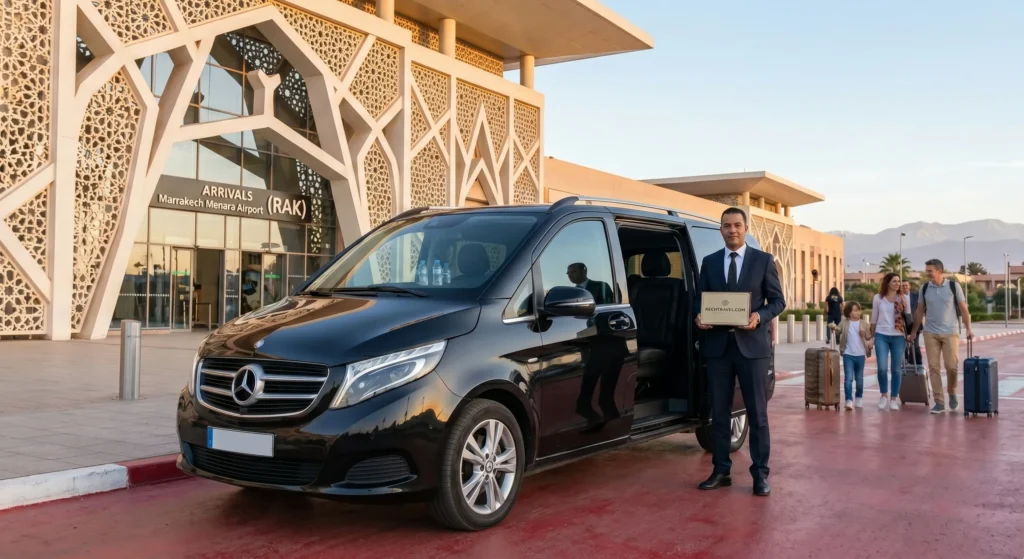
For a standard premium sedan (suitable for up to 3 passengers with moderate luggage), the baseline market rate for a one-way transfer between Marrakech Menara Airport and any centrally located hotel, Riad, or private villa ranges from €30 to €45 (approximately 300 to 450 MAD). For larger groups or those prioritizing maximum physical space, an executive minivan such as the Mercedes-Benz V-Class ranges from €50 to €75 (500 to 750 MAD). This rate structurally includes professional flight-tracking software integration, up to 60 minutes of complimentary driver wait-time from the moment your aircraft wheels touch the tarmac, all airport parking tariffs, luggage handling assistance, and a premium air-conditioned vehicle cabin stocked with chilled bottled water.
Caption: Premium meet-and-greet ground services utilizing executive vans directly outside the Arrivals Gate at Marrakech Menara Airport (RAK).
Intra-City Day Hire Calculations
When curating a dedicated day of urban exploration—visiting cultural landmarks like the Bahia Palace, the Saadian Tombs, Le Jardin Secret, and the iconic Majorelle Garden—booking a driver by the hour or by the day is structurally superior to booking individual point-to-point transfers. This keeps your vehicle statically staged at the exit of each monument, ready for immediate boarding without a single minute of transit latency.
A standard Half-Day Urban Disposition (4 consecutive hours of service within city limits) is priced between €60 and €90 for an executive sedan, and €90 to €130 for an executive multi-purpose vehicle (MPV). For a comprehensive, unrestricted Full-Day Urban Disposition (8 to 10 hours of driver availability), the 2026 benchmark pricing sits at €110 to €160 for sedans, and €160 to €240 for luxury vans. These day rates include a capped local mileage allowance (typically 100 kilometers within the city periphery), fuel costs, and the driver’s personal sustenance allocations.
Excursion Pricing Frameworks
Venturing outside the urban core into the diverse microclimates surrounding Marrakech alters the pricing matrix due to increased fuel consumption, wear-and-tear on challenging mountain typography, and extended driver hours. Day trips to the stunning, terraced landscapes of the Atlas Mountains tours, the waterfalls of Ouzoud, or the stark, otherworldly terrain of the Agafay Desert are structured as flat-rate out-of-town excursions.
A dedicated day trip to the Ourika Valley or an evening excursion to an Agafay Desert luxury camp typically commands a flat rate of €120 to €180. Extended long-distance day excursions—such as an early-morning departure to the historic UNESCO-listed coastal ramparts of Essaouira or the dramatic cascading waters of Ouzoud Falls—require roughly 6 to 8 hours of active highway driving and are valued between €180 and €280 per vehicle, depending entirely on the selected fleet classification.
Chapter 3: Fleet Logistics & Vehicle Architecture Selection
A critical error made by inbound travelers is failing to match their specific group dynamics and luggage volumes with the appropriate vehicle chassis. Luxury transport is deeply reliant on physical comfort and spatial ergonomics. For 2026, the elite transport fleets in Morocco have been carefully curated around specific engineering platforms to address distinct travel profiles.
The Executive Business Sedan: Mercedes-Benz E-Class & Alternatives
Designed for solo corporate travelers, couples, or digital nomads executing streamlined site visits, the premium executive sedan represents the pinnacle of aerodynamic urban transit. Boasting exceptional acoustic dampening, plush leather seating, and advanced climate control zones, these vehicles glide effortlessly through urban traffic. However, their physical luggage capacity is rigidly bounded by standard trunk dimensions. If your party consists of two individuals traveling with large, hard-shell international suitcases plus additional golf clubs or carry-on cases, a sedan will be structurally inadequate, necessitating an upgrade to an MPV chassis.
The Sovereign of Luxury Travel: The Mercedes-Benz V-Class
The undisputed backbone of premium transport in Marrakech is the Mercedes-Benz V-Class. This vehicle is explicitly engineered for multi-passenger comfort without compromising its elite luxury aesthetic. Featuring a highly modular cabin configuration, the V-Class is typically arranged in a face-to-face conference seating layout, allowing family members or corporate executive teams to converse naturally during transit.
The vehicle’s long-wheelbase variant easily accommodates up to 6 or 7 passengers alongside an extensive luggage cargo array. Its elevated ride height provides passengers with superior visibility over the surrounding landscapes, while its heavy-duty suspension system effortlessly irons out the minor road imperfections common on rural Moroccan routes. For groups executing complex multi-day itineraries, the V-Class is the definitive industry recommendation.
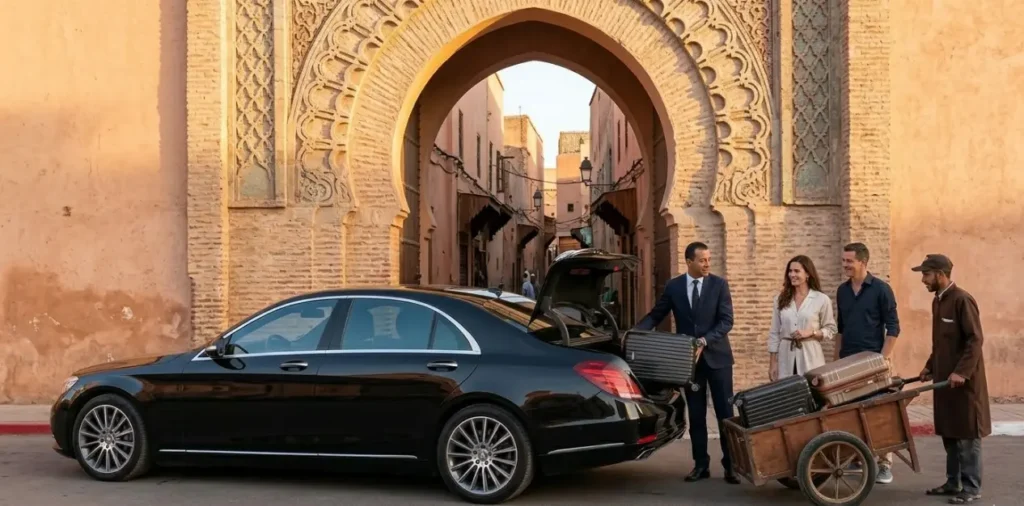
Caption: Premium Mercedes-Benz multi-passenger vehicle open configuration outside a historic Moroccan structural gateway, welcoming VIP clientele.
VIP Flagships: The Mercedes-Benz S-Class & Range Rover Elite
For state visits, high-net-worth individuals, celebrities, or travelers celebrating major life milestones, the standard luxury tier is superseded by VIP Flagship transport. The Mercedes-Benz S-Class represents an uncompromising masterclass in automotive engineering, featuring active air suspension, ventilated massage seating, and rear-seat entertainment screens. For remote excursions where rugged off-road capability must be seamlessly blended with haute-couture interiors, the long-wheelbase Range Rover Autobiography or Vogue is deployed. These vehicles operate under specialized pricing matrices, typically starting at €400 to €600+ per day, and require advanced reservations due to limited regional availability.
Chapter 4: Advanced Operational Logistics for Multi-Day Cross-Country Itineraries
True luxury transport reveals its operational excellence not during a brief airport run, but over the course of a complex, multi-day itinerary spanning thousands of kilometers across Morocco’s incredibly diverse geographical zones. A typical grand tour might link the luxury Riads of Marrakech to the high-altitude passes of Tizi n’Tichka, descending down into the ancient Ksar of Ait Benhaddou, threading through the Dades Gorge, and culminating in the deep desert dunes of Merzouga before charting a course north to Fes and Casablanca.
Driver Lodging and Sustenance Protocols
When you secure a private driver for an extended multi-day journey, the pricing model transitions into an all-inclusive daily rate. A common point of confusion for international clients is how the driver’s personal logistics are handled when staying overnight in remote destinations like Ouarzazate or a luxury desert camp in the Sahara.
When booking through an elite firm, the daily rate quoted is completely inclusive of the driver’s professional fee, fuel, highway tolls, vehicle maintenance, and critically, their personal overnight accommodation and meals. The driver manages their own lodging—often staying in dedicated staff quarters provided by luxury desert camps or utilizing pre-vetted local guesthouses. You are never expected to share your personal accommodation space or directly manage their meal arrangements, ensuring your party maintains absolute privacy throughout the vacation.
The Crucial Dynamics of Driving Hours and Road Safety
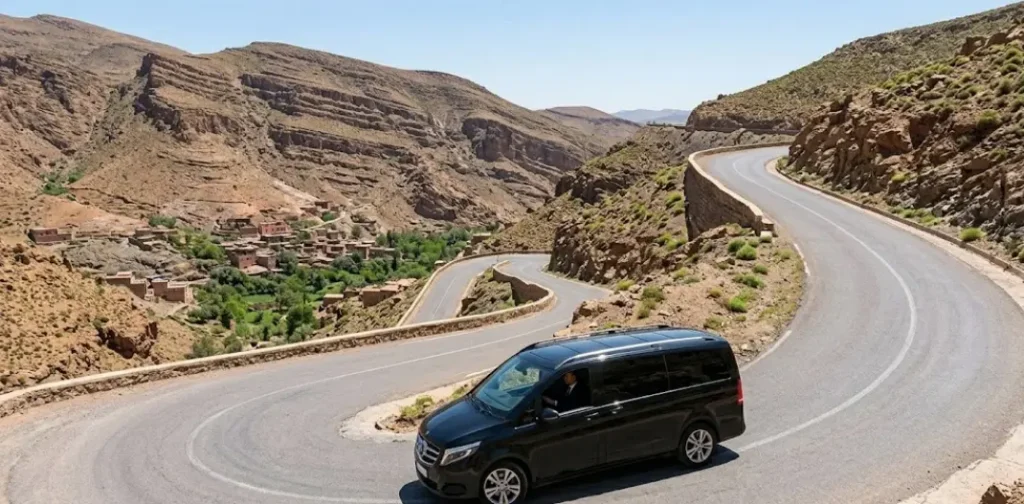
Morocco’s topography is jaw-droppingly beautiful, but it requires extreme driver focus. Crossing the Atlas Mountains involves navigating hundreds of tight switchbacks, managing steep descents, and adapting to sudden weather transitions from radiant sunshine to high-altitude fog or snow flurries. Professional transport firms strictly enforce European-aligned driving hour limitations to counter driver fatigue. A single driver should not exceed 8 hours of active steering wheel time per day, and comprehensive itineraries must factor in mandatory rest stops every 2 to 2.5 hours. These rest intervals are strategically synchronized with premium roadside panoramic points, artisanal cooperatives, or boutique cafes, transforming a safety requirement into a pleasant travel highlight.
Caption: Seamless navigation across scenic and winding high-altitude mountain pathways on regional Moroccan routes.
Chapter 5: Navigating the Medina – The ‘Last Mile’ Challenge Explained
The historic Medina of Marrakech is a UNESCO World Heritage site protected by imposing, centuries-old rammed-earth walls. Its interior is an intricate network of over 9,000 narrow, winding alleyways (‘derbs’) originally designed for pedestrian foot traffic, donkeys, and handcarts. With very few exceptions, cars are physically incapable of entering these ancient corridors. This introduces what luxury travel designers call the ‘Last Mile’ logistical challenge.
The Drop-Off Point Synchronization
If you have selected an ultra-exclusive luxury Riad situated deep within the quarters of Mouassine, Kennaria, or Bab Doukkala, your private vehicle cannot drive up to the front door. Instead, your professional driver will navigate to the absolute closest accessible vehicular gate or secure parking square (such as Sidi Mimoun, Place Jemaa el-Fna, or Bab Laksour).
A premium private driver service does not simply park the car and leave you to wander lost with your luggage. The arrival sequence is a coordinated handoff. Your driver communicates directly with your Riad’s management team while en route. Upon arrival at the designated vehicular drop-off point, a uniformed staff member or an official local luggage porter (‘kossa’) with a traditional wooden cart will be waiting statically at the curb to receive you, safely transferring your bags directly through the pedestrian labyrinth to your interior courtyard oasis.
Chapter 6: Unlocking Hidden Value – Insider Travel Secrets via Your Private Driver
While the primary function of a driver is safely transporting your party from point A to point B, an elite local driver acts as an invaluable cultural bridge, unlocking layers of Morocco that remain completely invisible to the average tourist relying on algorithmic guidebooks or surface-level travel forums.
The Anti-Scam Shield
The traditional marketplaces (souks) of Marrakech are exhilarating, but they can occasionally overwhelm uninitiated western visitors. Aggressive sales tactics, unrequested street guides leading travelers into dead-ends before demanding payment, and highly inflated initial prices are common elements of the urban experience. Having a dedicated private driver creates a powerful psychological shield. Your driver can advise you on realistic local market pricing for premium items like authentic Moroccan rugs, pure argan oil, and hand-hammered brassware before you step out of the vehicle. If a situation in the public square becomes uncomfortable, a quick phone call brings your driver directly to the edge of the pedestrian zone to extract your group cleanly.
Bypassing the Mainstream Tourist Traps
The typical tourist circuit in Marrakech is heavily saturated. A driver possessing decades of localized experience knows exactly how to read the rhythms of the city. They can suggest the optimal departure times to experience the Majorelle Garden before the massive tour buses arrive, or guide you to authentic, hidden culinary gems far outside the tourist-heavy zones of the central square—such as elite local mechoui vendors serving slow-roasted clay-oven lamb to locals, or contemporary Moroccan avant-garde galleries in the industrial creative hub of Sidi Ghanem.
Chapter 7: Comprehensive 2026 Booking Checklist & Quality Verification
Before executing any financial deposits or signing transport contracts for your 2026 journey, you must verify that your chosen provider fulfills strict legal and operational benchmarks. The market contains informal operators who cut corners, exposing you to significant logistical and legal liabilities.
The Imperial Ministry Transport License (Tourist Transport Regulation)
In Morocco, operating commercial tourist transport requires a highly regulated, official license issued explicitly by the Ministry of Tourism and Transport. These vehicles carry distinct legal designations, including specialized license plates or official window decals indicating their authorization. This license guarantees that the vehicle undergoes rigorous bi-annual mechanical inspections, maintains professional-grade commercial passenger insurance, and that the driver has passed comprehensive background checks, medical clearances, and advanced defensive driving evaluations. Never hesitate to demand written verification of a firm’s official tourist transport credentials.
Communication Infrastructure and Technical Frameworks
A luxury service must be backed by modern communication tools. In 2026, the primary operational tool for real-time coordination across Morocco is WhatsApp. Ensure your transport provider offers dedicated, 24/7 English-speaking dispatcher support via WhatsApp. This enables you to seamlessly text minor itinerary adjustments on the fly—such as extending a long lunch at a scenic vineyard or requesting an early pickup from a late-night dinner venue—with instant, documented confirmation.
Are you prepared to elevate your 2026 Moroccan travel experience to the absolute peak of safety, elegance, and uncompromised comfort? Do not leave your critical ground logistics to chance. Contact the elite reservation team at KechTravel today via our dedicated private transportation contact portal to lock in your bespoke vehicle allocations and secure an impeccable journey through the kingdom.